
Subhash Chandra Insolvency Case 2026: NCLT Order, ₹22,006 Crore Claims, ₹6.25 Crore Repayment Plan & What It Means for Creditors
19 min read
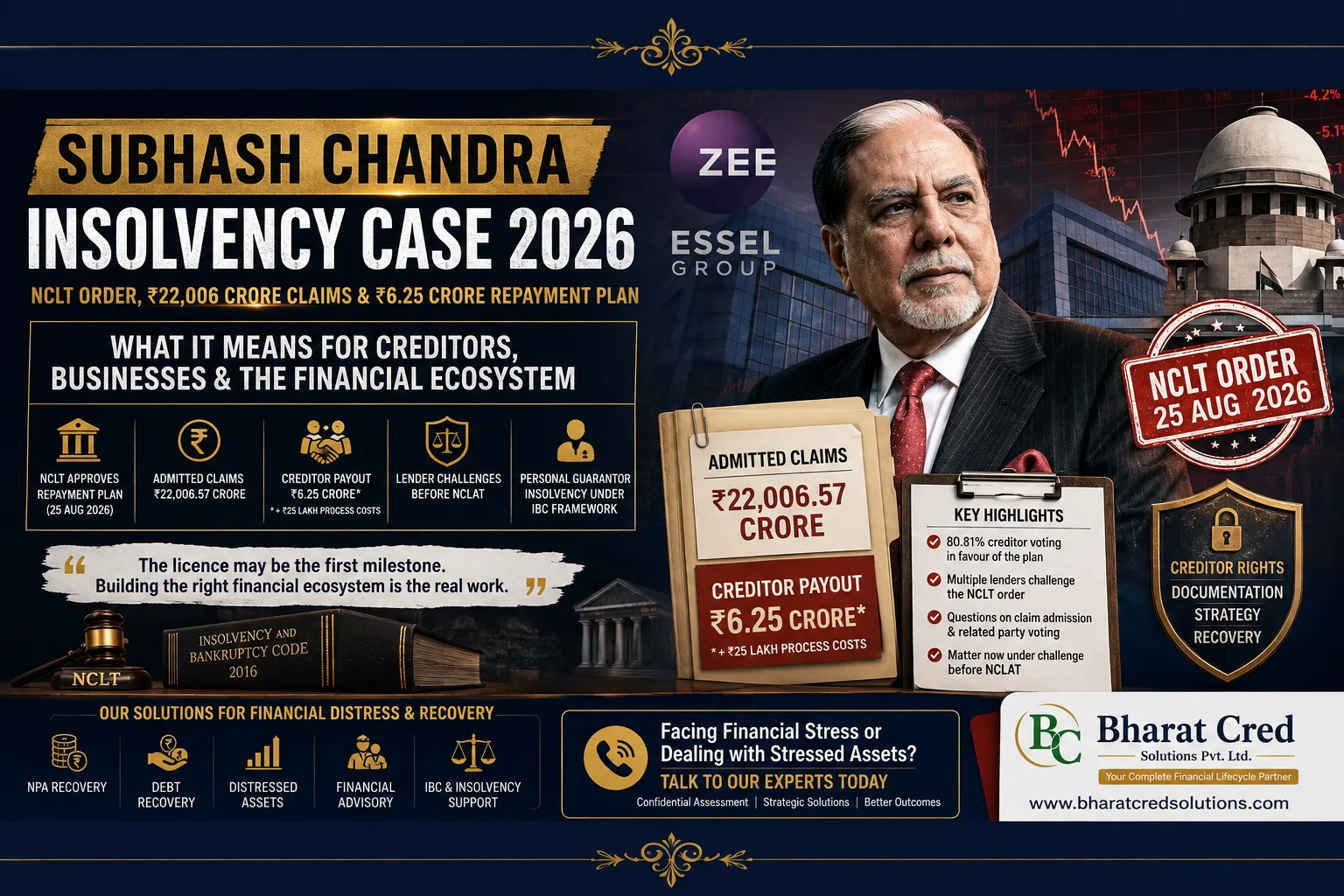
The Subhash Chandra insolvency case has become one of the most closely watched personal-guarantor insolvency matters in India after the National Company Law Tribunal (NCLT) approved a repayment plan in August 2026 involving admitted creditor claims of approximately ₹22,006.57 crore.
Under the approved plan, creditors are proposed to receive ₹6.25 crore, with another ₹25 lakh allocated towards the insolvency process, taking the total plan value to approximately ₹6.5 crore. Based on the admitted claims reported in the proceedings, that implies recovery of roughly 0.03% and a haircut of approximately 99.97%.
The case has attracted significant attention because the proceedings concern Subhash Chandra in his capacity as a personal guarantor to corporate debt, rather than an insolvency admission against Zee Entertainment Enterprises itself. The NCLT case is officially listed by the Insolvency and Bankruptcy Board of India as Indiabulls Housing Finance Limited vs. Dr. Subhash Chandra, Company Petition No. (IB)-97(ND)/2022, with the 25 August 2026 order recorded as “Approval of Repayment Plan in PG case.”
The matter is also not necessarily at its final judicial stage. Several lenders have announced or initiated challenges to the NCLT decision before the National Company Law Appellate Tribunal (NCLAT).
At the same time, Subhash Chandra has disputed the way the headline ₹22,000-crore number is being interpreted, stating that he was a guarantor rather than the personal borrower and that the figure represents claims filed in the insolvency proceedings rather than money he personally borrowed.
This article explains what happened, why the case matters, how personal-guarantor insolvency works under India's Insolvency and Bankruptcy Code (IBC), what a repayment plan means, why creditors are challenging the outcome, and what businesses and creditors can learn from the case.
Quick Answer: What Happened in the Subhash Chandra Insolvency Case?
On 25 August 2026, the NCLT approved a repayment plan in the personal-guarantor insolvency proceedings involving Essel Group chairman and Zee founder Subhash Chandra.
The proceedings recorded approximately ₹22,006.57 crore of admitted claims against him in the personal-guarantor process.
The approved plan provides:
₹6.25 crore → creditors
₹25 lakh → insolvency process costs
Total plan value → approximately ₹6.5 crore
The plan had received approximately 80.81% of the voting value from participating creditors before the tribunal's approval. Several lenders opposed the plan and have moved or announced challenges before NCLAT.
The important legal point is that this was a personal-guarantor repayment process, not a finding that Subhash Chandra personally borrowed ₹22,006 crore in his own capacity. Chandra has publicly disputed that characterization and says the relevant figure represents claims associated with guarantees given for borrowing entities.
1. Is This Really the "Zee Insolvency Case"?
Not exactly.
This distinction matters.
Subhash Chandra is widely known as the founder and chairman emeritus of Zee Entertainment Enterprises and chairman of the Essel Group. But the current NCLT matter concerns his personal insolvency proceedings as a personal guarantor to corporate debt.
The official IBBI listing identifies the proceeding as:
Indiabulls Housing Finance Limited vs. Dr. Subhash Chandra
and records the 25 August 2026 order as approval of a repayment plan in a Personal Guarantor (PG) case.
Therefore, it is more accurate to refer to the matter as:
Subhash Chandra personal insolvency case
Subhash Chandra personal-guarantor insolvency case
Subhash Chandra NCLT repayment-plan case
Essel Group founder insolvency case
rather than simply saying:
"Zee Entertainment is insolvent."
That statement would be misleading.
2. Who Is Subhash Chandra?
Subhash Chandra is the founder of the Zee media group and chairman of Essel Group.
The current insolvency proceedings relate to guarantees associated with borrowings of companies linked to the broader Essel business ecosystem.
This is important because a personal guarantee can create personal exposure for a guarantor even when the underlying borrowing was taken by a company.
That principle is one of the most important lessons from the case.
3. Why Is the ₹22,006 Crore Figure Being Reported?
The proceedings recorded admitted claims of approximately:
₹22,006.57 crore
This is the figure that has generated much of the public attention.
However, the headline number should be interpreted carefully.
Subhash Chandra has stated publicly that the figure does not mean he personally borrowed ₹22,000 crore from banks or financial institutions.
According to his clarification, the relevant obligations arose from personal guarantees connected to loans taken by borrowing entities.
India Today reported that Chandra said the ₹22,000-crore figure referred to guarantees linked to various borrowing entities and that he had not personally borrowed the amount.
Business Standard also reported Chandra's clarification that the ₹22,006 crore figure represented the total claims filed in the proceedings, while he disputed the characterization of the amount as his personal borrowing.
Therefore:
Claim amount ≠ necessarily money personally borrowed by the guarantor.
The legal significance lies in the guarantees, enforceability, claims admitted into the insolvency process and the liabilities legally attributable to the personal guarantor.
4. What Repayment Plan Did the NCLT Approve?
The approved repayment plan provides approximately:
₹6.25 crore to creditors
and:
₹25 lakh towards the insolvency process
for a combined value of roughly:
₹6.5 crore
against admitted claims of about:
₹22,006.57 crore.
The resulting recovery for creditors is approximately 0.03% of admitted claims, implying a very large haircut.
However, it is important not to describe the order simply as:
"NCLT ordered banks to accept a 99.97% haircut."
That is an oversimplification.
Business Standard reported that the repayment plan had been put before creditors and obtained the required majority support before the tribunal considered its approval under the IBC framework.
5. How Did the Repayment Plan Get Approved?
The creditor voting process is central to understanding the case.
According to reporting on the proceedings:
23 creditors participated in the voting process.
The repayment plan received approximately 80.81% of the voting value.
The creditors opposing the plan collectively represented approximately 19.186% of the voting value.
This distinction is important:
A creditor can oppose a repayment plan, but the outcome of the statutory voting mechanism depends on the voting share recognized under the applicable insolvency framework.
The controversy in the case therefore moved beyond the amount being paid.
It also became a question of:
Who was entitled to vote?
Which creditor claims should have been admitted?
How should relationships between entities and the personal guarantor have been treated?
6. Why Are Some Lenders Challenging the NCLT Order?
Several lenders have raised objections to the approved plan.
Among the lenders challenging or considering challenges are:
HDFC Bank
LIC Housing Finance
Canara Bank
Union Bank of India
LIC Housing Finance, Canara Bank and Union Bank have announced plans to challenge the NCLT approval before NCLAT.
The objections are not limited to the recovery amount.
They include issues concerning:
creditor voting
admission of claims
alleged relationships between certain creditors and the debtor
the treatment of alleged associate/related entities
scrutiny of creditor claims
whether the insolvency process was properly conducted
7. The Disputed Creditor Voting Issue
One of the most significant controversies concerns the entities whose votes supported the repayment plan.
Indian Express reported that several lenders alleged that five entities linked to Subhash Chandra's family or associated business network collectively held approximately 61.78% of the votes cast and supported the plan. Chandra's office denied the characterization and disputed the assertion that those companies qualified as associates under the IBC.
The entities discussed in reporting include:
Veena Investments Pvt Ltd
Direct Media Distribution Ventures Pvt Ltd
World Crest Advisors LLP
Lemonade Capital Advisors LLP
Corpcall Capital Advisors LLP
The issue is significant because the recognition or exclusion of creditor voting rights can materially affect the outcome of a repayment plan.
But these allegations should not be presented as established wrongdoing unless and until finally determined by the competent judicial forum.
8. NCLT Also Examined Claim-Admission Issues
Reporting on the NCLT order also highlighted concerns relating to the admission and verification of certain claims.
Indian Express reported that the tribunal identified discrepancies in 1,260 individual claims that had been admitted without what it considered adequate documentary verification. The reported claims included groups of individuals whose claimed entitlements were allegedly linked to financial assistance said to have been promised by Chandra.
The broader lesson is important:
Claim verification is one of the foundations of an insolvency process.
A creditor claim should be supported by appropriate documentary evidence and subjected to the scrutiny required under the applicable framework.
For both debtors and creditors, maintaining a clear documentary trail can become extremely important.
9. What Is Personal Guarantor Insolvency?
A personal guarantor to a corporate debtor can become subject to an insolvency resolution process under the IBC framework.
A personal guarantee generally means that an individual has undertaken to meet specified obligations if the underlying borrower fails to meet them.
When a company defaults, enforcement of the underlying company's obligations can therefore have consequences for the guarantor as well.
The IBC provides a dedicated framework for insolvency resolution involving personal guarantors to corporate debtors.
IBBI maintains separate regulations governing the insolvency resolution process for personal guarantors and the subsequent bankruptcy framework. Those regulations were amended in 2026.
10. Why Personal Guarantees Matter for Business Owners
Many promoters and directors sign personal guarantees while obtaining:
business loans
project finance
working-capital facilities
corporate guarantees
structured debt
financial-institution funding
A personal guarantee can create consequences that extend beyond the company's balance sheet.
This is why promoters should understand:
exactly what has been guaranteed
which borrowing entity is involved
the guarantee amount
invocation conditions
collateral
indemnity provisions
lender rights
enforcement mechanisms
A personal guarantee should never be treated as merely a formality attached to corporate borrowing.
11. What Does the Subhash Chandra Case Teach Creditors?
The case highlights several practical lessons.
Verify Every Claim
The stronger the documentation, the stronger the creditor's position in the process.
Understand the Voting Structure
A creditor's economic size and voting share are critical to the outcome of a repayment plan.
Monitor Related-Party Issues
Where creditors or claimants have relationships with a debtor, those relationships can become highly relevant to voting and claim-admission disputes.
Understand Personal Guarantees
Creditors should evaluate the enforceability and documentation of guarantees carefully.
Preserve Evidence
Loan agreements, guarantee deeds, board approvals, correspondence, invocation notices, security documentation and account statements can become critical evidence.
Monitor the Process Early
Waiting until the final hearing can leave creditors with fewer practical options.
12. What Does the Case Teach Business Owners?
The case also provides important lessons for promoters.
Understand Every Personal Guarantee
Do not sign guarantees without understanding the consequences.
Maintain Group-Level Financial Visibility
Promoters operating several companies should maintain clear separation of:
borrowing
guarantees
inter-company transactions
security
related-party arrangements
Keep Documentation Complete
If a dispute emerges years later, documentation becomes crucial.
Obtain Professional Advice Early
If a company is facing debt stress, waiting until insolvency proceedings are already advanced can reduce available strategic options.
13. What Happens After the NCLT Approval?
The latest publicly reported position is that the NCLT has approved the repayment plan, but the matter is being challenged by lenders.
LIC Housing Finance, Canara Bank and Union Bank have announced appeals before NCLAT, and HDFC Bank has also indicated plans/consideration to challenge the decision.
Therefore, as of 31 August 2026, the prudent description is:
NCLT-approved repayment plan, currently facing lender challenges/appeals.
The final legal outcome should not be predicted.
14. What Is NCLAT?
The National Company Law Appellate Tribunal (NCLAT) hears appeals against relevant orders of the NCLT.
Where a party believes that an NCLT decision requires appellate review, the IBC framework provides mechanisms for challenge subject to the applicable statutory requirements.
Therefore, the next stage of this dispute may involve:
NCLT order
↓
Appeal
↓
NCLAT
↓
Potential further judicial proceedings depending on the issues and applicable law.
15. What Is a Haircut in Insolvency?
A haircut generally refers to the difference between the amount claimed by creditors and the amount ultimately recovered under a resolution or settlement process.
In the Subhash Chandra case, reported admitted claims are approximately ₹22,006.57 crore while the plan provides ₹6.25 crore to creditors.
That produces an approximate recovery rate of:
0.03%
and an approximate haircut of:
99.97%
These figures describe the relationship between the admitted claims and the amount proposed under the approved plan, not necessarily the amount originally borrowed by Subhash Chandra personally.
16. Does a Large Insolvency Haircut Mean the Debt Was "Waived"?
Not necessarily.
An insolvency resolution plan determines the treatment of claims within the applicable statutory process.
A large haircut does not mean:
the original debt never existed
the creditor voluntarily gave up its rights outside the process
the original contractual amount was incorrect
every creditor agreed to the same commercial outcome independently
It means that the approved resolution mechanism determines how the admitted claims are dealt with.
The exact legal consequences depend on the plan, the order approving it and any appellate proceedings.
17. Why This Case Matters for India's Insolvency Framework
The case raises broader questions about:
Creditor protection
How effectively does the framework protect lenders when recoveries are extremely low?
Claim verification
How thoroughly should claims be examined before they influence voting?
Related-party participation
How should potentially connected creditors be treated?
Personal guarantor proceedings
How should promoter guarantees interact with corporate debt and insolvency?
Commercial settlements
How should creditor voting and tribunal review interact in large personal-guarantor cases?
These questions make the case relevant far beyond the Zee/Essel ecosystem.
18. Personal Guarantor vs Corporate Insolvency
This distinction is essential.
Corporate Insolvency
The insolvency process concerns a company that has defaulted on its financial obligations.
Personal Guarantor Insolvency
The proceedings concern an individual who has guaranteed obligations of a corporate debtor and is subject to the separate IBC framework applicable to personal guarantors.
Therefore:
A personal guarantor entering an insolvency process does not automatically mean the underlying corporate group is itself undergoing a new CIRP.
That is why describing the current Subhash Chandra matter accurately matters.
19. When Should a Business Seek Insolvency Advisory?
Professional advice should be considered well before an insolvency process reaches its final stages.
Potential warning signs include:
repeated loan defaults
cash-flow stress
lender notices
guarantee invocation
SARFAESI/DRT proceedings
multiple creditor disputes
inability to service interest
restructuring discussions
asset-sale pressure
recovery proceedings
legal notices
threatened insolvency proceedings
The earlier the situation is assessed, the more clearly the available options can be evaluated.
20. Insolvency Services for Creditors
Creditors may need support with:
claim preparation
claim documentation
claim verification
debt reconciliation
insolvency-process strategy
recovery analysis
distressed-asset assessment
settlement evaluation
resolution-plan analysis
portfolio recovery strategy
coordination with legal and insolvency professionals
The objective is not simply to file a claim.
It is to understand:
What is recoverable, through which route, at what cost and within what legal framework?
21. Insolvency Support for Promoters & Businesses
For a company or promoter facing financial distress, advisory may involve:
debt assessment
creditor mapping
financial restructuring
settlement strategy
guarantee analysis
restructuring options
insolvency-process assessment
documentation review
asset analysis
negotiation support
resolution strategy
Every case is fact-specific.
No responsible adviser should promise that a particular amount of debt will be "written off" or that a tribunal will approve a particular settlement.
22. How Bharat Cred Solutions Fits Into the Insolvency & Recovery Ecosystem
Bharat Cred Solutions is positioned across the wider financial lifecycle, including recovery, collections, distressed assets, financial advisory, NBFC compliance and financial operations. Its current service architecture includes NPA recovery, debt recovery, financial advisory and broader distressed-asset capabilities.
For creditors, lenders and financial businesses, relevant areas can include:
NPA Recovery
Portfolio assessment, recovery-value estimation, OTS negotiation, legal recovery coordination, collateral realisation support and NPA MIS.
Debt Recovery
Commercial debt and receivable assessment, structured follow-up, settlement negotiation and coordination with legal counsel.
Financial Advisory
Financial assessment, capital structuring, portfolio profitability, risk/treasury advisory and strategic financial modelling.
Distressed Assets
Assessment of stressed portfolios, recovery prospects and potential resolution strategies.
23. Why Insolvency Advisory Should Begin With the Numbers
In a distressed situation, the first question should not always be:
"How do we fight the case?"
It should often be:
"What is the economic reality of the situation?"
That means understanding:
Total debt
↓
Secured debt
↓
Unsecured debt
↓
Personal guarantees
↓
Available collateral
↓
Realistic recovery value
↓
Cash-flow position
↓
Legal exposure
↓
Resolution options
This allows creditors or promoters to make decisions based on actual economics rather than headlines.
24. A Practical Insolvency Assessment Checklist
If you are a creditor or business owner dealing with financial distress, start by collecting:
Debt
☐ Loan agreements
☐ Sanction letters
☐ Account statements
☐ Security documents
☐ Guarantee deeds
☐ Invocation notices
☐ Restructuring documents
Legal
☐ Notices
☐ Court/tribunal orders
☐ Recovery proceedings
☐ Existing litigation
☐ Regulatory correspondence
Financial
☐ Latest financial statements
☐ Cash-flow statements
☐ Asset schedule
☐ Liability schedule
☐ Receivables
☐ Payables
☐ Security valuation
Operational
☐ Current business status
☐ Revenue
☐ Profitability
☐ Working capital
☐ Employees
☐ Key contracts
Resolution
☐ Settlement possibility
☐ Restructuring possibility
☐ Recovery route
☐ Asset-sale opportunity
☐ Insolvency route
☐ Strategic investor possibility
25. Frequently Asked Questions
Is Zee Entertainment itself insolvent in the Subhash Chandra case?
The recent NCLT proceeding is against Subhash Chandra in his capacity as a personal guarantor to corporate debt. The official IBBI record identifies the matter as Indiabulls Housing Finance Limited vs. Dr. Subhash Chandra and describes the 25 August 2026 order as approval of a repayment plan in a personal-guarantor case.
What is the Subhash Chandra insolvency case?
It is a personal-guarantor insolvency proceeding involving Subhash Chandra and creditor claims connected to guarantees associated with corporate borrowings.
How much debt is involved in the Subhash Chandra insolvency case?
The reported admitted creditor claims are approximately ₹22,006.57 crore.
How much will creditors receive?
The approved plan provides approximately ₹6.25 crore to creditors, plus ₹25 lakh towards process costs.
What is the approximate haircut?
Relative to the reported ₹22,006.57 crore of admitted claims, the proposed creditor recovery is about 0.03%, implying a haircut of roughly 99.97%.
Did Subhash Chandra personally borrow ₹22,000 crore?
Chandra has publicly disputed that characterization and said he did not personally borrow ₹22,000 crore. He says the figure relates to claims arising from personal guarantees connected with borrowing entities.
Why are banks opposing the repayment plan?
Lenders have raised objections concerning the plan, creditor voting, claim admission and the treatment of certain entities alleged to be associated with the debtor. Several lenders have announced appeals/challenges.
Has the NCLT order become final?
As of August 31, 2026, the NCLT has approved the repayment plan, but lenders have announced or initiated appellate challenges. Therefore, the broader dispute remains subject to further proceedings.
What is a personal guarantor under the IBC?
A personal guarantor is an individual who has provided a personal guarantee in relation to the debt of a corporate debtor and can become subject to the insolvency framework applicable to personal guarantors.
Can directors and promoters face personal insolvency?
A director or promoter can potentially face personal-guarantor insolvency where they have provided a personal guarantee and the statutory conditions for initiating the relevant process are satisfied.
What should creditors do when a borrower becomes insolvent?
Creditors should promptly review the debt documents, guarantee, claim evidence, security, recovery prospects, procedural deadlines and applicable insolvency strategy.
What insolvency services does Bharat Cred provide?
Bharat Cred's current financial lifecycle services include NPA recovery, debt recovery, distressed-asset support, financial advisory, NBFC compliance and broader financial operations.
Can Bharat Cred guarantee debt recovery?
No responsible adviser should guarantee a particular recovery amount or tribunal outcome. Recovery depends on the facts, documentation, assets, legal route and decisions of the competent authorities.
26. What Businesses Should Learn From the Subhash Chandra Case
The most important lesson is not simply the size of the numbers.
It is that debt, guarantees, creditor claims, voting rights, documentation and insolvency strategy are interconnected.
For promoters:
Understand the consequences of personal guarantees before signing them.
For creditors:
Protect the claim with strong documentation and active process monitoring.
For businesses under stress:
Seek restructuring or insolvency advice before the situation becomes irreversible.
For investors:
Evaluate distressed opportunities based on realistic recovery values, not headline debt.
For financial institutions:
Maintain clear borrower, guarantor, security and claim records.
27. Need Insolvency, Debt Resolution or Recovery Advisory?
Financial distress requires a strategy—not just a reaction.
Whether you are:
a lender with a stressed exposure
a creditor pursuing recovery
a promoter facing financial distress
a company evaluating restructuring
an investor evaluating distressed assets
an NBFC managing an NPA portfolio
a business dealing with guarantee-related liabilities
the first step is to understand your actual financial and legal position.
Bharat Cred Solutions provides financial-lifecycle support across:
Recovery → NPA Resolution → Debt Recovery → Financial Advisory → Distressed Assets
Our current NPA recovery service covers portfolio assessment, recovery-value estimation, OTS negotiation, legal recovery coordination, collateral realisation support and recovery MIS.
Speak With the Bharat Cred Team
Request a Confidential Financial Distress Assessment
We'll review your situation, understand the underlying exposure and help identify the appropriate next steps.
Bharat Cred Solutions Pvt. Ltd.
India's Complete Financial Infrastructure Partner
Conclusion
The Subhash Chandra insolvency case of 2026 is significant not merely because the reported claims run into thousands of crores, but because it illustrates how India's insolvency framework can intersect with personal guarantees, corporate borrowing, creditor voting, claim verification and repayment-plan approval.
The NCLT's 25 August 2026 order approved a repayment plan under which approximately ₹6.25 crore would be distributed to creditors against reported admitted claims of about ₹22,006.57 crore. The approval followed majority creditor support, while several lenders have challenged or announced plans to challenge the outcome before NCLAT.
At the same time, Subhash Chandra has disputed the public interpretation of the ₹22,000-crore figure and emphasized that he was acting as a personal guarantor rather than the direct borrower.
The case therefore deserves to be understood carefully rather than reduced to a headline about a "₹22,000-crore debt being settled for ₹6.5 crore."
For creditors, promoters, NBFCs, lenders and investors, the larger lesson is clear:
Strong documentation.
Early risk assessment.
Accurate claim verification.
Active insolvency-process monitoring.
And a realistic recovery strategy.
Those fundamentals can matter as much as the headline value of the debt itself.
Legal & Regulatory Disclaimer
This article is intended for general information and educational purposes only. It is not legal advice, insolvency advice for a specific matter, accounting advice, or a substitute for advice from a qualified insolvency professional, advocate, Chartered Accountant or other appropriate professional.
The Subhash Chandra matter remains subject to the tribunal orders and any appellate proceedings. Reported allegations by creditors or other parties should not be treated as final findings unless determined by the competent authority.
Readers should verify the latest NCLT/NCLAT/IBBI orders, applicable provisions of the Insolvency and Bankruptcy Code, and other relevant regulations before taking action.
Have a specific question about this?
Talk it through with our team on a strategy call.